
VL4ASD: Virtual Learning for People With Autistic Spectrum Disorders
| Partners | Michigan State University (MSU), Department of Counselling, Educational Psychology and Special Education, Dr. Yurgos Politis, and University College Dublin |
| Focus | Conversation and social communication skills |
| Research environment | Collaborative 3D virtual world |
| Technical platform | R&D.Construct and OpenSim |
| Learning methods | Presentations, demonstration videos and virtual character interaction |
| Evaluated participants | Three autistic participants |
| Intervention | 15 to 16 sessions per participant |
| Study design | Four phases of structured physical and virtual conversations |
| Research areas | Autism, conversation skills, virtual environments, personalised learning and responsible research |
| Research outputs | Peer reviewed publications in 2017 and 2019, with the completed study appearing in Advances in Autism, Volume 6, Issue 1 |
‘Involving People with Autism in Development of Virtual World for Provision of Skills Training’
International Journal of E-Learning and Distance Education, (Politis, Olivia, Olivia, & Sung, 2017)
https://www.ijede.ca/index.php/jde/article/view/1032
Testing conversation skills training through a collaborative 3D virtual environment
VL4ASD was a research project exploring whether a shared 3D virtual environment could support conversation skills training for autistic young adults.
The project combined structured learning materials, virtual interaction and practical conversation exercises within a digital environment designed to provide a controlled setting in which participants could learn and practise social communication skills.
The work resulted in peer reviewed research documenting both the development of the training environment and the subsequent conversation skills intervention.
The challenge
Conversation involves a complex combination of skills.
Someone needs to know how to begin an interaction, identify an appropriate topic, respond to another person, maintain the exchange and recognise when and how to end it.
Communication also involves factors such as personal space, attention and non verbal behaviour.
For some autistic people, practising these skills directly in everyday social situations can introduce additional pressure and uncertainty.
VL4ASD investigated whether some of this learning and practice could instead take place within a virtual environment, where situations could be structured around the needs of the individual and repeated where useful.
Creating a space for conversation practice
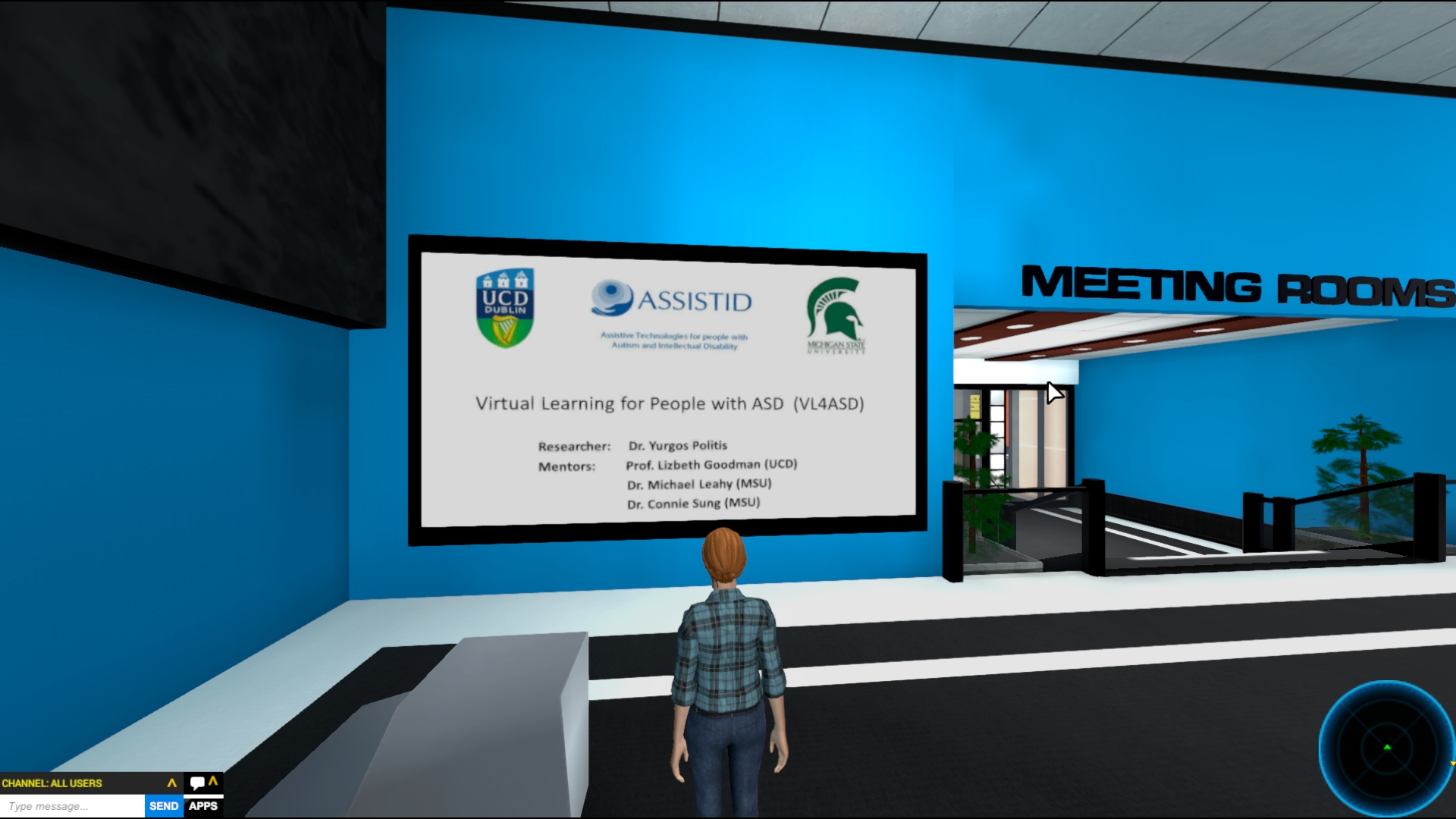
VL4ASD used a collaborative virtual world in which participants were represented by avatars and could interact with other people and virtual characters.
The environment was designed to provide a safe setting in which conversation scenarios could be practised without many of the pressures associated with an unfamiliar physical environment.
The research focused particularly on conversation with another person, including skills such as initiating a conversation, choosing suitable subjects, sustaining an interaction and ending a conversation appropriately.
The technical platform used for the project was described in the published research as an early iteration of the R&D.Construct powered 3DNovations platform. Development work used OpenSim for creation of training material, while R&D.Construct was selected for delivery of the intervention because it allowed greater customisation of the virtual environment.
Learning in different ways
The project deliberately avoided relying on a single form of instruction.
Participants encountered conversation skills through three principal learning formats.
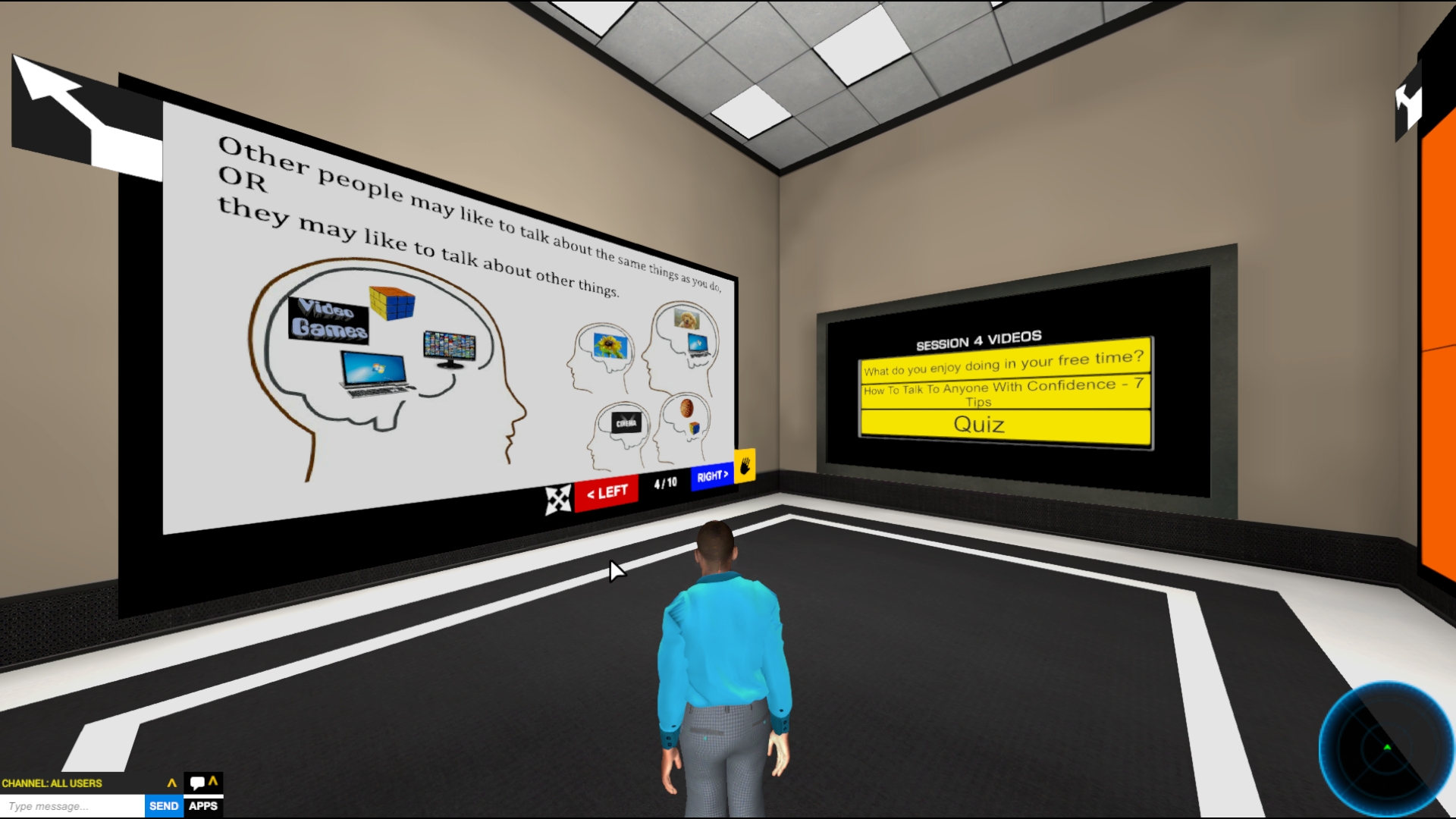
Presentations explained the skills and concepts being introduced.
Videos demonstrated examples of those skills being used.
Virtual character interaction gave participants an opportunity to practise them.
Participants later described these three approaches as useful because they represented different stages of learning: being taught what to do, seeing an example and then practising the skill themselves.
This combination allowed the virtual world to operate as more than a meeting space. Teaching material and practical exercises could be brought together inside the same learning environment.
From virtual learning to real conversation
A central question for the project was whether practising conversation virtually could have relevance beyond the virtual world.
The completed research therefore used structured conversations delivered both physically and virtually.
Three autistic participants took part in a multiple baseline study involving 15 to 16 sessions per participant across four phases.
The design allowed researchers to examine participants across different stages of interaction and instruction rather than simply asking whether they enjoyed using the technology.
The broader research design also considered whether skills practised within the virtual environment could subsequently be demonstrated during physical interaction.
Personalised learning
VL4ASD was designed around the principle that social communication training should not assume that every participant has the same requirements.
Earlier project planning proposed reviewing each participant’s educational information and consulting with participants and people who knew them well in order to identify appropriate individual goals.
Training scenarios could then be adapted around those circumstances rather than requiring every participant to complete an identical intervention.
This was particularly important for conversation skills, where an area that presents difficulty for one person may not be a priority for another.
What participants thought
Feedback from participants was positive about the potential of virtual environments for autism related training.
Participants particularly valued the combination of presentations, videos and virtual character interaction.
The researchers reported that participants felt these different formats could support learning because they allowed a skill to be explained, demonstrated and then practised.
Earlier development feedback from both autistic users and practitioners had also been positive about the potential value of the training materials.
The findings were exploratory rather than evidence from a large trial, but they provided support for further research into virtual environments as a method for delivering structured skills training.
A proof of concept
VL4ASD was deliberately a small research study.
The completed intervention involved three participants, so its results should not be interpreted as demonstrating effectiveness across autistic populations generally.
Instead, the project provided a proof of concept through which researchers could examine how conversation skills training might be structured inside a virtual environment and identify issues requiring further development.
That distinction is important.
The value of the project was not that it established virtual training as a replacement for conventional approaches. It demonstrated a practical model that could be developed, tested and evaluated further.
Potential beyond conversation skills
Conversation was selected as the initial application, but the underlying approach had wider possibilities.
The 2017 research identified potential future applications involving other communication skills as well as life skills, academic skills and vocational training.
A virtual environment can allow learning scenarios to be repeated, adapted and accessed remotely. This creates possibilities for training situations that might otherwise be difficult, expensive or stressful to reproduce physically.
VL4ASD therefore provided a test case for a broader question: how collaborative 3D environments could support personalised skills development for people who may benefit from practising situations before encountering them in everyday life.
Research and publication
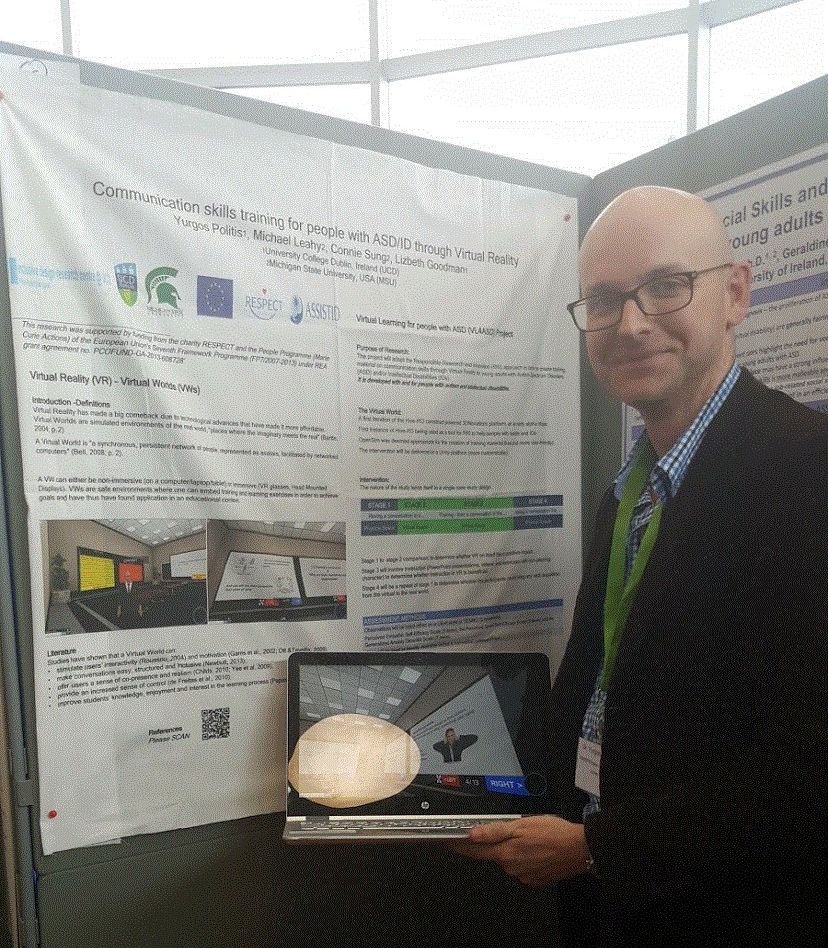
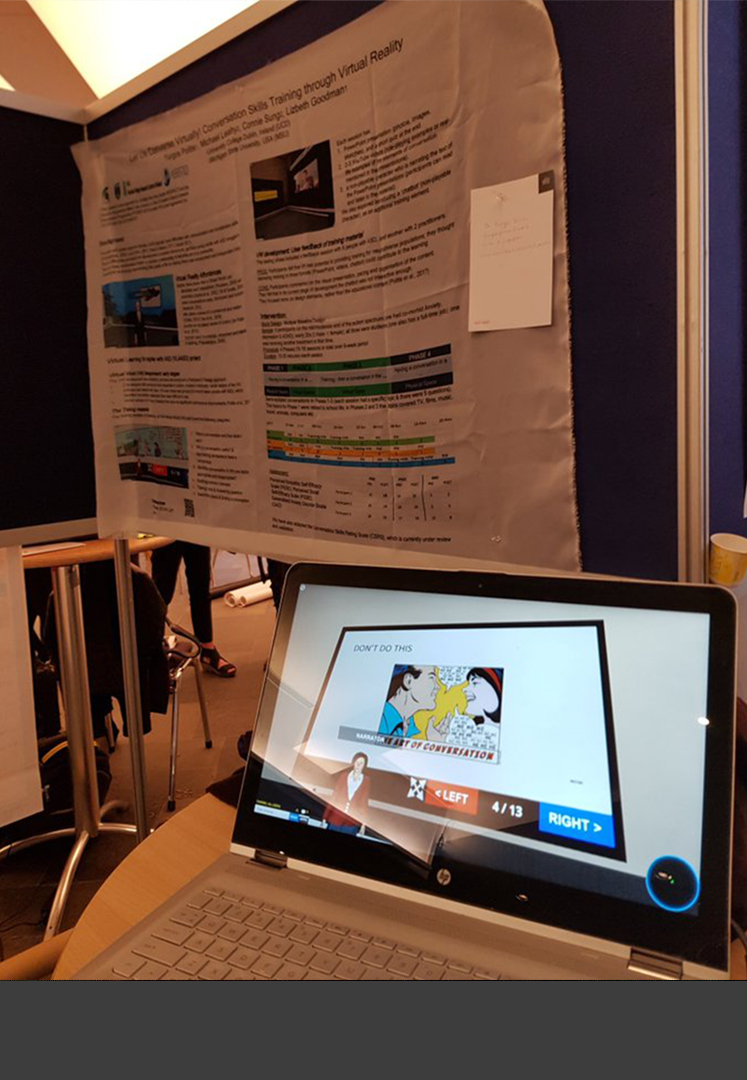
The VL4ASD work contributed to several peer reviewed research outputs.
In 2017, Yurgos Politis published Involving People with Autism in Development of Virtual World for Provision of Skills Training in the International Journal of E Learning and Distance Education. The paper documented the development phase of the virtual world and the planned VL4ASD conversation skills training.
The project was also described that year within People with Disabilities Leading the Design of Serious Games and Virtual Worlds, which documented the proposed intervention, technical platform and evaluation approach.
The completed conversation skills study was subsequently published as Conversation skills training for people with autism through virtual reality: using responsible research and innovation approach in Advances in Autism. The paper documented the three participant study, the 15 to 16 sessions and the four phases of structured conversation training.
This provides a peer reviewed academic record of both the development and evaluation of the project.
Project impact
VL4ASD demonstrates how immersive technology can be developed around a specific learning and research problem rather than simply presenting users with a virtual environment and expecting useful outcomes to follow.
The project combined software development, learning design, structured intervention, personalised training and formal academic evaluation.
For 3DNovations, it forms part of a longer history of applying collaborative 3D technology to education, accessibility and skills development.
It also demonstrates experience of working alongside academic researchers to translate a research question into a functioning technical intervention that could be used and evaluated with participants.