3D Virtual Eye Clinic
| Sector | Health and higher education |
| Academic partner | Cardiff University School of Optometry and Vision Sciences |
| Technology and development | 3DNovations and Resound Training |
| Funder | Central Optical Fund |
| Project type | Proof of concept and evaluation |
| Participants | 19 optometry students |
| Clinical cases | Cataract, glaucoma and wet age related macular degeneration |
| Technology | Multi-user 3D virtual environment with avatars, virtual patients and interactive ophthalmic equipment |
| Evaluation | Quantitative learning assessment, interaction analysis, group discussions, observation, video analysis and tutor feedback |
| Project report | Published November 2020 |
https://www.centralfund.org.uk/3d-virtual-eye-clinic/
3DNovations worked with the School of Optometry and Vision Sciences at Cardiff University and Resound Training to develop and evaluate a 3D virtual optometry clinic for clinical education.
The project explored whether students could use a shared virtual clinic to work through realistic patient cases, make clinical decisions and discuss patient management remotely.
An interactive clinic was created containing avatars, virtual patients and optometric equipment. The project then compared learning within the 3D environment with a conventional discussion based learning environment.
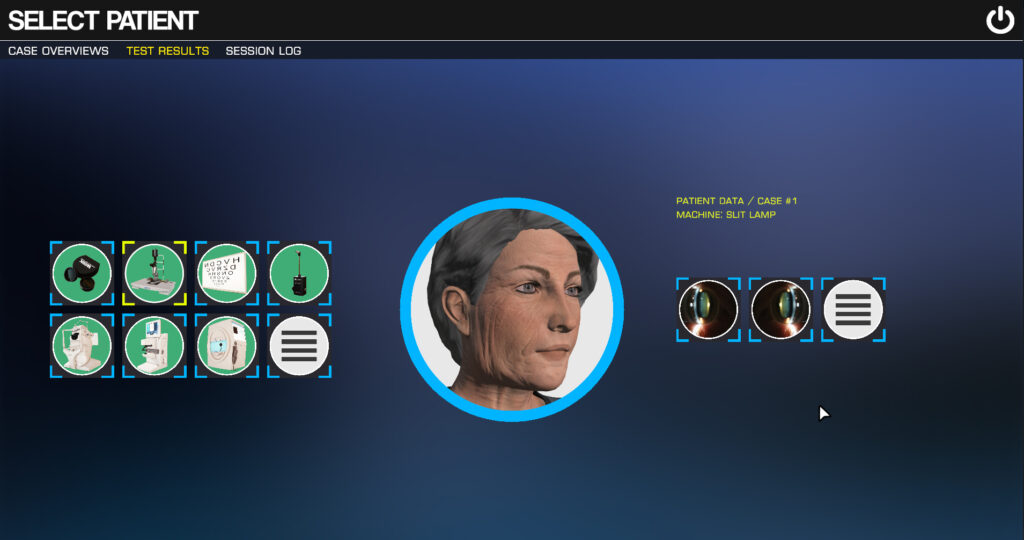
A participant sits opposite a computer controlled patient
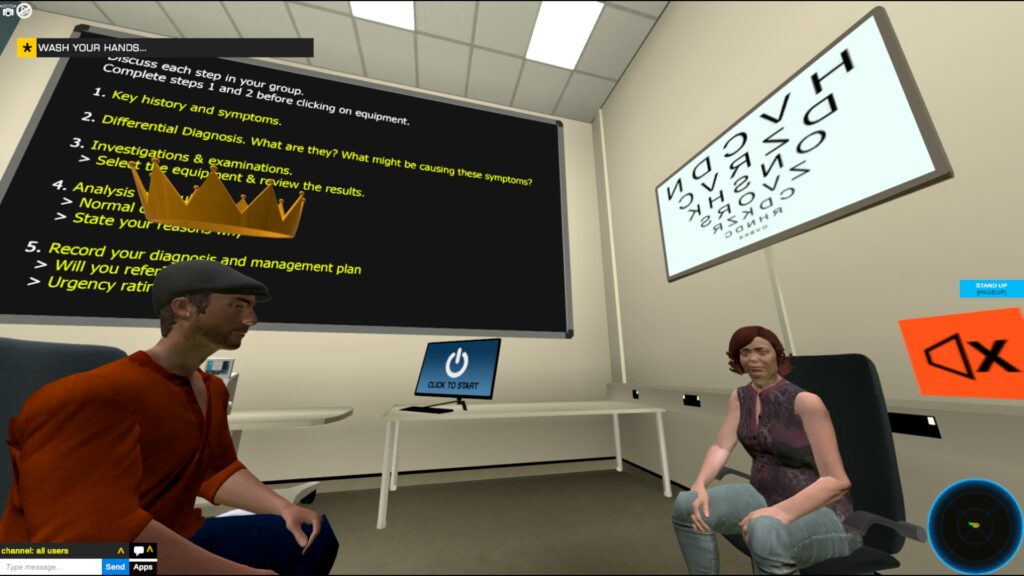
Specific patient data from an Optical Coherence Tomography (OCT) machine scan
The challenge
Clinical education requires students to develop more than theoretical knowledge.
Optometry students need opportunities to interpret patient histories, evaluate clinical findings, reach diagnoses and make appropriate management decisions.
Physical clinical environments provide this context, but they depend on access to facilities, staff and suitable patients. They are also difficult to reproduce remotely.
The project therefore investigated whether a shared 3D environment could provide a safe digital space in which students could practise elements of clinical reasoning and patient management without requiring a real patient to be present.
Creating the virtual clinic
The project team developed a virtual optometry clinic designed to resemble a real clinical environment closely enough for students to recognise its professional purpose.
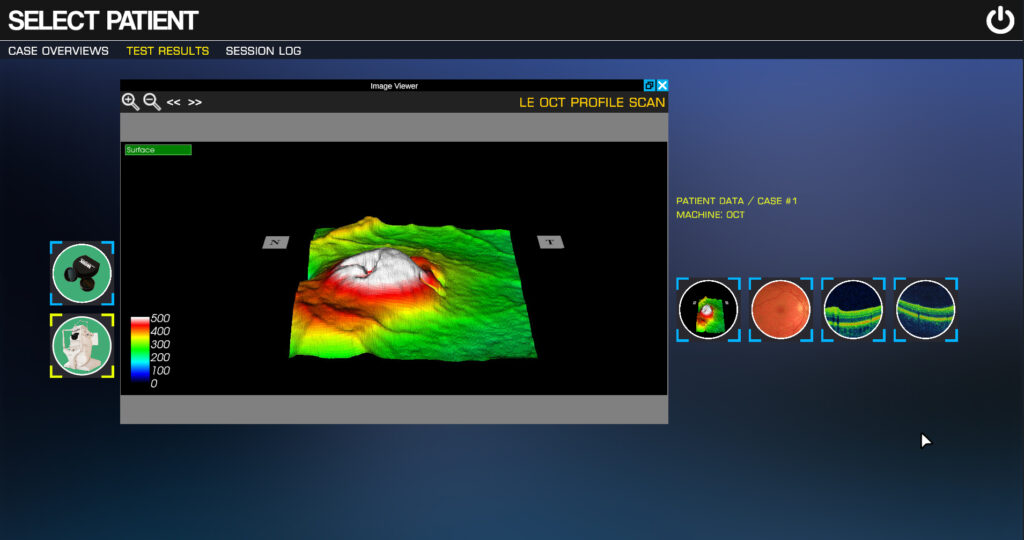
The clinic contained virtual examination equipment, patient avatars and spaces in which students could work together.
An advisory board involving optometry educators, academics, an electronic learning technologist and other Cardiff University specialists contributed to the design. Feedback from this group was used to refine the layout and increase the clinical credibility of the environment.
Students entered the clinic through avatars and could move around the environment, communicate with one another and interact with clinical equipment.
The platform supported voice and text communication, allowing participants to discuss patient cases while occupying the same shared virtual space.
Recreating clinical equipment
A significant part of the development work involved reproducing the information students would normally obtain from ophthalmic examination equipment.
Within the virtual clinic, students could interact with equipment to access clinical information including:
– Visual acuity results
– Current spectacle prescriptions
– Anterior segment examination information
– Fundus images
– Intraocular pressure results
– Visual field plots
– Optical coherence tomography images and videos
The position of equipment was reviewed with the project team and advisory group to make the space more representative of real optometric practice.
This was important because the project was intended to test clinical reasoning rather than simply give students a virtual space to explore.
Building realistic patient cases
Three clinical scenarios were developed for the pilot.
They covered:
– Cataract
– Glaucoma
– Wet age related macular degeneration
Each virtual patient had a detailed history including symptoms, general health, medication, previous ocular history, family history, employment and lifestyle information.
The learning objectives were aligned with the General Optical Council Stage 2 competencies relating to ocular abnormalities.
Students could listen to or read patient histories before examining the available clinical evidence.
One student took the role of the lead practitioner for each case, while other members of the group examined the evidence and contributed to the diagnosis and management discussion.
Learning through interaction
Students were able to move independently around the clinic and examine different pieces of virtual equipment.
Clinical results could be accessed directly from the relevant equipment rather than being presented as a conventional sequence of slides.
This allowed students to investigate a case individually while still participating in a group discussion.
The platform also allowed students to record their diagnosis and proposed treatment plan and discuss their reasoning through voice and text communication.
This combination of individual exploration and collaborative decision making became one of the interesting findings from the project.
Evaluating the virtual clinic
The pilot involved 19 optometry students.
Eleven were third year undergraduate students and eight were first year postgraduate students.
Across four study sessions, participants worked through the three clinical cases. Researchers assessed knowledge before and after the sessions and analysed communication between students.
The study found a statistically significant overall improvement in knowledge across the participating students.
When the 3D environment was compared with the conventional discussion environment, no statistically significant difference was found between them in pre session scores, post session scores or the amount of learning improvement.
This was an important result.
For this small pilot, the virtual clinic performed comparably with the conventional learning environment while also allowing students to explore clinical information independently and participate remotely.
Individual and collaborative learning
Researchers observed that the virtual environment supported different approaches to learning.
Some students explored the available clinical objects independently before contributing their findings to the group.
Others worked through the clinical evidence collectively.
The project report noted that this type of individual exploration within a shared learning environment was not possible in the comparison setting used by the study.
Students could therefore move between self directed investigation and collaborative discussion without leaving the same digital environment.
Student experience
Researchers also carried out group discussions and analysed recordings of students using the clinic.
Students generally described the environment as engaging, visual and enjoyable. Some reported that working within the virtual clinic made them feel more like practitioners than simply discussing the same information during a lecture.
An interesting finding concerned the balance between playfulness and clinical realism.
Students were comfortable using avatars and some of the less formal features of the virtual environment, but they also wanted the clinical tools themselves to resemble the materials they would use in real practice.
For example, students wanted realistic patient record cards rather than a more generic digital note tool.
This provided useful design evidence for future development of immersive professional training environments.
Testing remote presence
The students participating in the evaluation were physically distributed across separate rooms within the university.
This allowed researchers to examine whether participants nevertheless experienced themselves as working together inside the virtual environment.
Analysis of the sessions found active discussion across both voice and text communication. Researchers observed collaborative behaviour and evidence that students experienced a sense of shared presence despite being physically separated.
Tutor feedback
Three tutors also entered and evaluated the virtual clinic.
Tutors identified considerable potential for using the environment with optometry students, particularly for learners who could not easily attend physical teaching environments.
They also identified areas for further development, including more sophisticated interaction with virtual patients, real time feedback and a larger library of patient cases.
One suggested direction was for virtual patients to respond dynamically to the questions and clinical decisions made by students.
This would allow future versions of the environment to assess not only whether students reached the correct answer, but also how they gathered the information required to reach it.
What the project demonstrated
The project provided evidence that a collaborative 3D environment could support clinical case based education.
The evaluation found that the virtual clinic:
– Supported measurable learning
– Performed comparably with the conventional discussion environment used in the study
– Allowed independent exploration alongside collaborative learning
– Provided a shared clinical environment for geographically separated learners
– Allowed realistic patient cases and clinical evidence to be incorporated into a virtual space
– Provided students with a safe environment in which to practise clinical decision making
– Showed potential for distance learning and professional education
The Central Optical Fund subsequently highlighted the project as an example of innovative development in optometry education.
Limitations and lessons learned
The project was a proof of concept rather than a large clinical education trial. The research involved only 19 students, meaning its findings should not be generalised to optometry education as a whole. Testing also identified technical and usability issues.
These included bandwidth and connection problems during the tutor session, limitations in the interaction available between avatars and the need for better feedback and assessment tools.
These findings were useful because the purpose of a proof of concept was not simply to demonstrate what worked.
It was also to identify what would need to change before the technology could be developed into a larger educational platform.
Potential for future development
The project team identified several possible directions for further development.
These included creating a larger library of clinical cases, making cases easier for educators to add themselves, providing real time student feedback and assessment, improving patient interaction and extending access across additional devices and platforms.
The project report also identified the potential for wider partnership working between higher education and commercial organisations, including applications beyond the original optometry pilot.
Project impact
The 3D Virtual Eye Clinic demonstrated how an immersive environment could be designed around a genuine professional education requirement rather than used simply as a visual demonstration.
Clinical equipment, patient information, learning objectives and collaborative decision making were brought together within one shared environment.
For 3DNovations, the project demonstrates experience in adapting immersive technology to specialist professional training, working with academic and subject experts, translating real clinical processes into interactive digital experiences and contributing to formal evaluation of the resulting platform.
A wider view of part of the training area
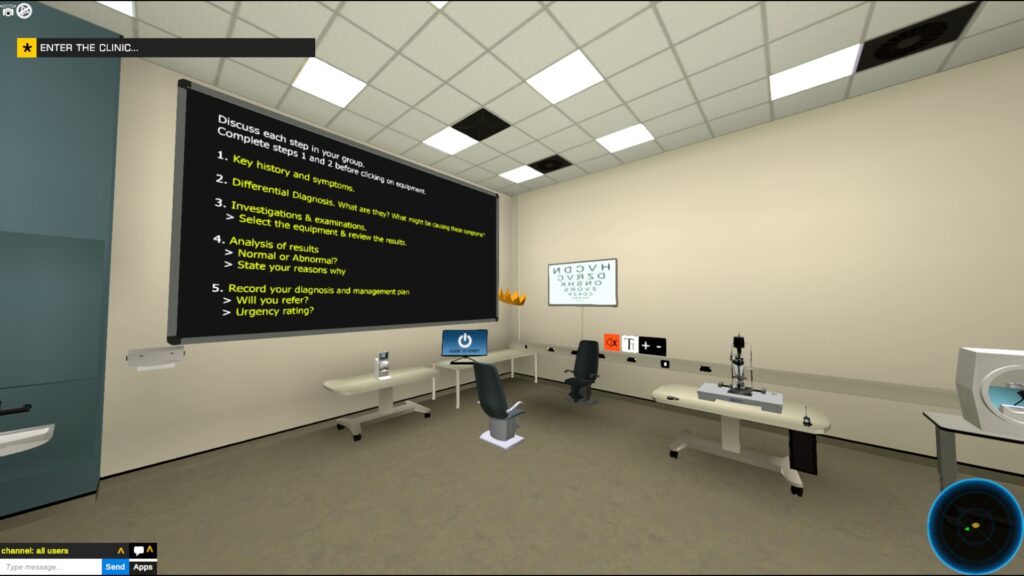
An example of the user interface for accessing ophthalmic examination equipment containing specific patient data